
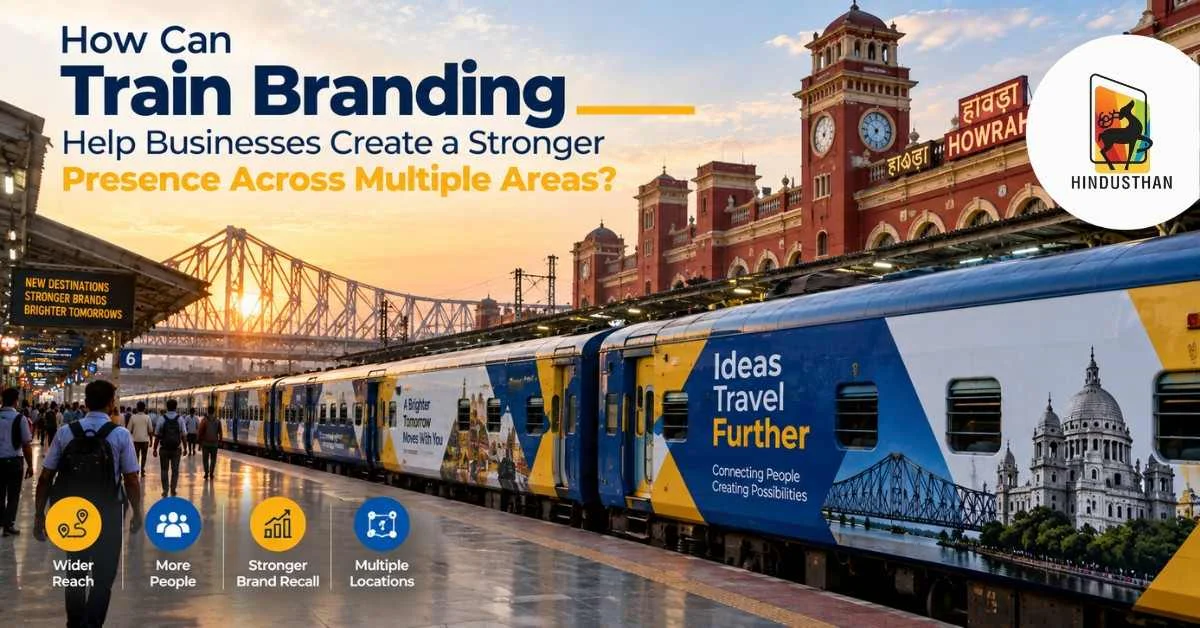
A billboard has a location. A train has a journey.
That simple difference changes the entire advertising game.
Imagine a brand message moving through busy neighbourhoods in the morning, crossing commercial districts during the day, and reaching another part of the city by evening. Instead of waiting for people to pass an advertisement, the advertisement itself travels through the places where people live, work, shop, and commute.
That is what makes train branding such a fascinating outdoor advertising medium. It turns an ordinary train into a moving brand experience and lets businesses build visibility across multiple areas through one coordinated campaign.
What Makes a Moving Advertisement So Powerful?
Static advertising depends heavily on a single location. A train is different because it carries the brand from one location to another.
A branded train can travel through several neighbourhoods and transport corridors during its regular operation. Every station, platform, road crossing, and surrounding area can create another opportunity for the campaign to be seen.
This mobility gives the brand a broader physical presence without requiring separate advertisements at every individual location.
The train essentially becomes a travelling piece of the campaign.
How Does It Help a Brand Reach Multiple Areas?
Geographical reach is one of the biggest advantages of train branding. A business may want to target customers in several parts of a city rather than concentrate its entire campaign in one area.
A train naturally supports this objective because its route connects different locations.
A passenger boarding in one neighbourhood may see the branding at the beginning of their journey, while another person may notice the same train several stations later. People outside the train can also encounter the campaign as it arrives, departs, or moves through the city.
One branded vehicle can therefore create multiple touchpoints along its route.
Why Does Repetition Matter?
Advertising is rarely about one perfect encounter. It is about creating familiarity.
When the same branded train runs repeatedly along a particular route, audiences can encounter the campaign again and again. A commuter may see it on Monday, recognise it on Wednesday, and become completely familiar with it after several weeks.
This repeated exposure can strengthen brand recognition because the audience is not simply seeing a message once; they are repeatedly encountering the same visual identity within their everyday routine.
The result can be a brand that gradually becomes part of the visual memory of a route.
Can Train Branding Do More Than Display a Logo?
It should.
A train provides a large canvas, which means brands can think beyond conventional advertisements. The exterior can become a visual story rather than a collection of logos and information.
Creative designs can use large imagery, bold typography, colour contrasts, characters, product visuals, or storytelling concepts that work across the length of the train.
For example, instead of treating each coach as a separate advertisement, a campaign can connect multiple coaches into one continuous visual narrative. As the train moves past an audience, the individual sections can feel like different frames of the same story.
That is where creativity turns visibility into an experience.
What About Audiences Inside and Outside the Train?
This is another interesting advantage.
The campaign can potentially communicate with two different audiences at the same time.
Passengers inside the train may experience the branding during their journey, while pedestrians, motorists, commuters, and people waiting near stations may see the exterior from outside.
This creates multiple viewing situations from a single advertising asset.
However, the creative needs to account for these different audiences. Exterior advertising must be understood quickly from a distance, while interior communication can afford to contain more information because passengers may have longer viewing time.
Why Is Route Selection So Important?
A beautifully designed train on the wrong route is still a poorly planned campaign.
The route determines where the brand appears, who encounters it, how frequently it is seen, and what kind of environment surrounds the advertisement.
Businesses should therefore look beyond passenger numbers. The surrounding commercial areas, residential zones, educational institutions, offices, shopping destinations, interchange points, and daily movement patterns can all influence the value of a route.
The strongest campaigns begin with the audience and then work backwards toward the route.
How Can Businesses Make the Campaign More Memorable?
The answer is not necessarily more information. It is better communication.
People do not usually have time to read a long paragraph while a train is moving past them. A memorable campaign should make its central message obvious within seconds.
A strong visual, distinctive colour scheme, short message, recognisable brand identity, and clever creative concept can work together to create that instant connection.
The goal is simple: first make people notice, then make them remember.
Is Train Branding Suitable for Every Business?
Not automatically.
It is particularly useful for brands that want broad geographic visibility, repeated exposure, and a strong physical presence. Consumer brands, retail businesses, financial services, educational institutions, real estate companies, healthcare organisations, entertainment brands, and large corporate campaigns can all potentially benefit from the format.
But choosing train branding simply because it offers a large canvas is not enough. The campaign should have a clear objective, suitable route, appropriate creative, and realistic duration.
Conclusion
Train branding can turn a regular transportation network into a moving communication platform for a brand. Its real strength comes from combining mobility, scale, repetition, and geographic reach.
Instead of occupying one advertising location, the brand travels through multiple areas and repeatedly enters the everyday view of different audiences.
And that is the real difference.
A static advertisement says, “Come and see me here.”
A moving campaign says, “You are going to see me wherever the journey takes you.”
When strategy and creativity come together, a train can become far more than a vehicle. It can become a moving landmark for the brand, one that travels through the city, creates repeated encounters, and gradually builds a presence that people recognise.