
Hindusthan | Outdoor Advertising Agency

Uncategorized

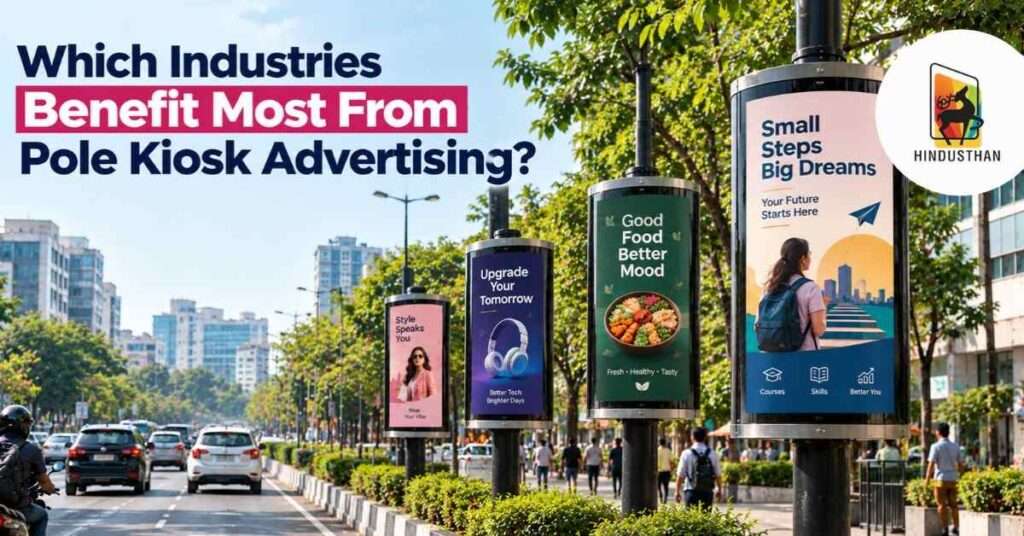
Ultra-realistic urban street with pole kiosk advertisements displaying fictional slogans for education, retail, health, and lifestyle brands, alongside modern buildings, greenery, and city traffic.

Which Industries Benefit Most From Pole Kiosk Advertising?

Pole kiosk advertising is a practical outdoor marketing format that helps businesses communicate with people as they move through streets, commercial areas, and public spaces. Positioned along selected roads and pedestrian routes, pole kiosks can display promotional messages, brand visuals, event announcements, and service information. Their effectiveness depends on location, visibility, campaign duration, and how closely the surrounding audience matches the business’s target customers. Industries That Can Gain From Pole Kiosk Advertising Different industries can use pole kiosks to improve local awareness and support their wider marketing activities. The format is particularly useful for businesses that want to reach people in specific neighbourhoods or create repeated visibility along frequently travelled routes. 1. Real Estate and Property Developers Real estate companies can use pole kiosk advertising to promote residential projects, commercial properties, new launches, and property exhibitions. Placing advertisements near developing neighbourhoods, connecting roads, and relevant commercial zones can help introduce projects to people who live or work nearby. Simple creative designs featuring project highlights, location details, and contact information can make the message easier to understand. Campaigns should focus on areas relevant to the property rather than choosing locations based only on traffic volume. 2. Retail Stores and Shopping Brands Retail businesses often depend on local awareness to attract customers to physical stores. Clothing outlets, supermarkets, electronics shops, jewellery stores, and shopping centres can use pole kiosks to communicate seasonal offers, new collections, store openings, and promotional events. Advertising near shopping districts and busy connecting roads can help shoppers become familiar with a brand before visiting. For stronger results, the message should be concise and any offer should have clear terms and a valid campaign period. 3. Educational Institutions and Training Centres Schools, colleges, coaching centres, vocational institutes, and professional training providers can use pole kiosks to promote admissions, entrance preparation courses, skill-development programmes, and upcoming enrolment dates. Locations near educational neighbourhoods, residential areas, and suitable commuter routes may help institutions reach students and families. Campaign creatives should clearly present the course category, key dates, and contact details without overcrowding the advertisement with too much information. 4. Healthcare and Wellness Services Hospitals, diagnostic centres, dental clinics, eye-care providers, and wellness facilities can use pole kiosk advertising to increase awareness of their services. Displays near residential communities and relevant local routes can help people recognise nearby healthcare facilities. Messages may highlight the type of service offered, location, appointment information, or a new facility opening. Healthcare advertising should remain accurate, responsible, and compliant with applicable advertising regulations. 5. Food, Restaurants, and Hospitality Restaurants, cafés, quick-service food outlets, hotels, and event venues can use pole kiosks to promote their locations, special menus, seasonal campaigns, and new openings. Advertising near entertainment districts, office areas, shopping streets, and routes leading to the venue can support local discovery. A clear visual and a short message can make the advertisement easier to notice while people travel through the area. 6. Banking, Finance, and Insurance Banks, insurance providers, financial service companies, and lending businesses can use pole kiosk advertising to build recognition within selected markets. Campaigns may communicate branch openings, service availability, financial awareness initiatives, or brand-level messaging. For these businesses, consistent visibility in relevant commercial and residential areas can support familiarity. All financial claims and promotional messages should be transparent and comply with applicable regulations. 7. Entertainment, Events, and Consumer Brands Concert organisers, exhibition venues, cinemas, cultural festivals, and consumer product companies can use pole kiosks to promote events, launches, and seasonal campaigns. A coordinated series of displays can help establish a campaign presence across several relevant locations. Consumer brands can also use this format to reinforce awareness alongside digital advertising, social media, and other outdoor media. The creative should be visually distinctive and adapted to the viewing distance and environment. Factors That Influence Campaign Performance Industry suitability alone does not guarantee a successful campaign. Businesses should evaluate the audience profile, pedestrian and vehicle movement, viewing angles, surrounding obstructions, and the duration of exposure. The number and distribution of kiosks also matter: a carefully selected group of locations may be more useful than scattered placements without a clear audience strategy. Creative quality is equally important. Short headlines, readable typography, strong visuals, and a single clear message can help people understand the advertisement quickly. Where appropriate, a QR code or short web address can connect outdoor exposure with a digital destination, provided it is easy and safe for the audience to access. Making Pole Kiosk Advertising Part of a Wider Strategy Pole kiosk advertising can work as a standalone awareness campaign or as part of a broader outdoor marketing plan. Businesses may combine it with billboards, transit advertising, digital campaigns, and local promotions to create a more consistent brand presence. Media planning, location selection, permissions, production quality, and installation should be considered before a campaign begins. Reviewing the campaign’s objective and monitoring available performance indicators can also help businesses make better decisions for future advertising activity. Conclusion Pole kiosk advertising can benefit a wide range of industries, including real estate, retail, education, healthcare, hospitality, finance, and entertainment. Its greatest value comes from placing a clear message in locations that are relevant to the intended audience. By choosing suitable sites, designing easy-to-read creatives, and aligning placements with specific marketing goals, businesses can use pole kiosks to strengthen local awareness and complement their wider promotional efforts.

Large outdoor billboards along a busy Kolkata road featuring yellow taxis, commercial buildings, a flyover, and city traffic.

Where Should Brands Place Billboards in Kolkata for Maximum Visibility?

A billboard is not effective simply because it is large. Its real value depends on where it is placed, who passes it, how long the advertisement remains visible, and how often people encounter it. Kolkata offers a wide range of outdoor advertising environments, from busy commercial districts and corporate hubs to airport roads, major connecting corridors, and rapidly developing areas. Each location attracts a different mix of commuters, residents, professionals, shoppers, and visitors. For brands planning an outdoor campaign, choosing the right location is therefore just as important as creating the advertisement itself. Here are some of the important areas to consider when planning billboard advertising in Kolkata. 1. Park Street and Central Kolkata Park Street and the surrounding central areas remain important commercial and lifestyle destinations in Kolkata. The area attracts office workers, shoppers, tourists, business visitors, and people visiting restaurants and entertainment venues. This makes the area relevant for brands that want to create a premium urban presence. Depending on the available advertising inventory, brands can consider large-format displays, digital screens, and other strategically positioned outdoor formats. Suitable for: Luxury, hospitality, retail, financial services, automobiles, and lifestyle brands. 2. EM Bypass EM Bypass is one of Kolkata’s major connecting corridors and passes through a mix of residential, commercial, healthcare, hospitality, and business developments. Its broad road environment creates opportunities for larger outdoor advertising formats, while its connection to several important parts of the city provides access to a diverse audience. The surrounding presence of hospitals, residential projects, hotels, and commercial properties also makes the area relevant to location-specific campaigns. Suitable for: Real estate, healthcare, automobiles, retail, financial services, and consumer brands. 3. New Town and Rajarhat New Town and Rajarhat have become major modern residential and business destinations around Kolkata. The area includes IT offices, residential complexes, hotels, educational institutions, shopping destinations, and commercial developments. The audience here includes professionals, residents, students, shoppers, and visitors. Billboards and digital outdoor displays along important roads can help brands maintain visibility among people travelling through this rapidly developing part of the city. Suitable for: Technology, real estate, education, banking, automobiles, and lifestyle brands. 4. Kolkata Airport Corridor The routes connecting Kolkata with Netaji Subhas Chandra Bose International Airport provide another useful environment for outdoor advertising. Airport-bound traffic includes business travellers, tourists, professionals, residents, and people travelling between the airport and different parts of the city. Brands can use suitable locations along these routes to reach people in a travel-oriented environment. Suitable for: Hospitality, travel, automobiles, real estate, financial services, and premium consumer brands. 5. Salt Lake Sector V Salt Lake Sector V is one of Kolkata’s key corporate and technology districts. The area attracts a large professional audience during working hours, making it relevant for businesses targeting employees and working professionals. Advertising around Sector V can be particularly useful for companies whose customers are digitally active, professionally employed, or connected with the technology and business sectors. Suitable for: Technology companies, financial services, recruitment, education, real estate, food, and professional services. 6. Esplanade Esplanade is a major commercial and transportation zone in central Kolkata. Its surrounding areas experience movement from commuters, shoppers, office workers, public transport users, and visitors. The combination of commercial activity and transportation makes it useful for brands looking for broad urban visibility. Digital displays and large-format advertising can be considered depending on available media locations. Suitable for: Retail, consumer brands, telecommunications, education, entertainment, and financial services. 7. Howrah and the Howrah Bridge Approach The Howrah Bridge and its surrounding approaches form one of the most recognisable connections between Howrah and Kolkata. The area experiences significant movement between the two sides of the Hooghly and can provide brands with exposure to commuters travelling into and out of Kolkata. For businesses looking for broad visibility across Kolkata and Howrah, suitable advertising locations around this corridor can be considered. 8. VIP Road and Other Major Connecting Roads VIP Road is an important route connecting Kolkata with the airport and several northern and eastern parts of the city. Advertising along such connecting roads can provide repeated exposure to people travelling between residential neighbourhoods, commercial areas, offices, and transportation hubs. The same principle applies to other major roads: the best location is not necessarily the busiest road, but the one where the intended audience regularly travels. How Should You Choose a Billboard Location? Selecting a billboard based only on its size or traffic volume can be a mistake. Several factors should be considered before finalising a location. Know Your Audience: A luxury brand, real estate company, restaurant, educational institution, and consumer brand will not necessarily benefit from the same location. Check Visibility: The billboard should be clearly visible from an appropriate distance. Buildings, trees, flyovers, road structures, and other advertisements can affect visibility. Consider Traffic Direction: The direction from which people approach the advertisement matters. A billboard should be positioned so that the audience has enough opportunity to notice and understand the message. Think About Frequency: A location used repeatedly by commuters can help build familiarity with a brand over time. Keep the Creative Simple: Even the best location cannot compensate for an advertisement that is difficult to understand. A strong visual, clear branding, short message, and easy-to-read typography are important for outdoor campaigns. Is the Biggest Billboard Always the Best? Not necessarily. A massive billboard in a location where the target audience rarely travels may deliver less useful exposure than a smaller display positioned along a regular commuter route. Outdoor advertising should therefore be evaluated according to location, audience, visibility, frequency, and context, rather than physical size alone. How Can Media Space Help? Planning a billboard campaign involves more than finding an available advertising surface. Location selection, media availability, creative requirements, production, installation, and campaign duration all need to be coordinated. Media Space can assist businesses with location planning, media selection, creative adaptation, production, installation, and campaign execution. This can help brands build an outdoor campaign based on their specific audience and geographical requirements rather than simply selecting a billboard because