
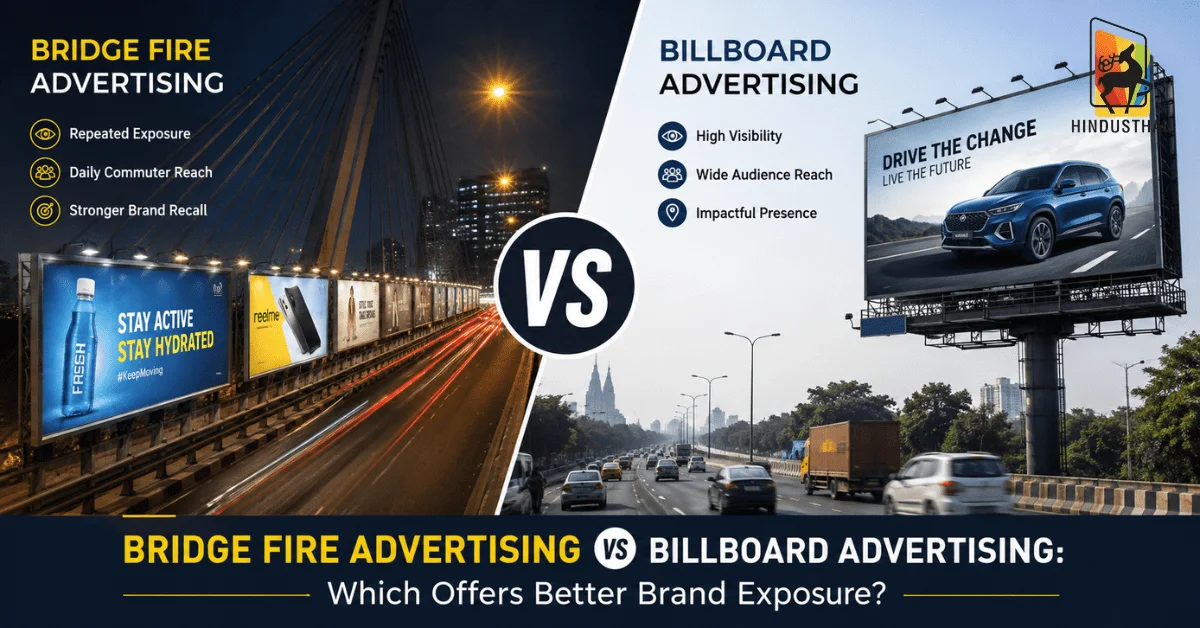
Outdoor advertising offers brands multiple ways to capture public attention, but not every advertising format delivers visibility in the same manner. Two commonly used Out-of-Home (OOH) media are bridge fire advertising and billboard advertising. While both help brands reach large audiences, they differ in placement, viewing behaviour, campaign objectives, and audience engagement.
Understanding these differences helps businesses select the right advertising format based on their marketing goals rather than simply choosing the largest display.
Understanding Bridge Fire Advertising
Bridge fire advertising refers to illuminated advertising panels installed along bridges and flyovers where traffic movement remains consistent throughout the day. Because commuters often travel the same routes repeatedly, these advertisements receive frequent exposure from the same audience.
Unlike many outdoor formats that rely primarily on one-time impressions, bridge fire displays are designed to reinforce brand recall through repeated visibility. This makes them suitable for campaigns that aim to stay in the minds of commuters over an extended period.
How Billboard Advertising Works
Billboards are large-format advertising structures positioned beside highways, arterial roads, commercial zones, and major intersections. Their primary objective is to create immediate visual impact and attract attention from both moving traffic and pedestrians.
With larger creative space, billboards allow advertisers to showcase bold imagery, concise messaging, and strong branding. They are commonly used for product launches, corporate campaigns, public awareness initiatives, and large-scale promotional activities.
Bridge Fire Advertising vs Billboard Advertising
Although both formats belong to outdoor advertising, they perform differently depending on campaign objectives.
Audience Exposure
Bridge fire advertising focuses on repeated exposure among regular commuters who travel the same route daily. Billboards generally reach a broader audience, including residents, visitors, and long-distance travellers.
Visibility Pattern
Bridge fire displays remain within a commuter’s line of sight while travelling across bridges and flyovers, helping reinforce brand familiarity over time. Billboards rely on their size and strategic placement to generate immediate attention from a greater distance.
Campaign Objective
Bridge fire advertising is often suitable for campaigns that prioritise long-term brand recall and consistent visibility. Billboards are generally selected when brands want to maximise awareness quickly across a wider geographical area.
Creative Approach
Since both formats are viewed while audiences are in motion, creative designs should remain simple, visually strong, and easy to understand within a few seconds. Clear headlines, limited text, high contrast, and recognisable branding usually produce better results.
Which Format Is Better?
There is no universal answer because the right choice depends on the campaign’s objective.
Bridge fire advertising is often preferred when the goal is consistent exposure among daily commuters. Billboard advertising may be more suitable when businesses want maximum visibility across major roads or highways.
Many successful outdoor campaigns combine multiple OOH formats to increase reach while maintaining consistent brand recall across different locations.
Factors to Evaluate Before Choosing
Before investing in any outdoor advertising format, businesses should consider:
- Target audience movement
- Traffic density at the location
- Campaign duration
- Brand awareness objectives
- Creative requirements
- Budget allocation
- Frequency of audience exposure
Choosing the right location often has a greater impact than selecting the largest advertising structure.
Why Planning Matters
The effectiveness of an outdoor campaign depends not only on the advertising medium but also on strategic planning. Factors such as placement, visibility angle, traffic flow, campaign timing, and creative execution collectively influence overall performance.
A well-planned campaign ensures that advertisements reach the intended audience repeatedly while delivering clear and memorable communication.
Conclusion
Bridge fire advertising and billboard advertising each offer distinct advantages within the outdoor advertising landscape. Bridge fire advertising strengthens brand recall through repeated commuter exposure, while billboards provide large-format visibility capable of attracting attention across wider areas.
Instead of viewing one format as universally better, businesses should evaluate their campaign objectives, audience behaviour, and desired outcomes before selecting the most appropriate medium. Matching the advertising format to the campaign strategy ultimately delivers stronger visibility and more effective brand communication.